
Hotwife Lifestyle Psychology: Why Couples Are Drawn to This Dynamic
/ Hotwife & CuckoldingMost conversations about the hotwife lifestyle start with logistics: who, what, when, where, and how. The question that gets asked far less often, and matters far more, is why. Why are certain couples drawn to this dynamic? What is happening psychologically for both partners when the arrangement feels genuinely exciting, bonding, and sustainable? What separates the couples who thrive in this dynamic from those who find it destabilizing?
Hotwife lifestyle psychology is not a niche academic curiosity. It is the foundation that determines whether this kind of relationship structure works over time. Couples who understand their own motivations, fears, and emotional patterns before they explore are far better equipped to communicate clearly, set meaningful boundaries, and actually enjoy the experience. Those who skip this step often encounter problems that feel surprising but were, in retrospect, entirely predictable.
This guide explores the psychological landscape of the hotwife lifestyle in depth. It covers what research says about consensual non-monogamy, how attachment theory applies to couples who explore outside traditional structures, what drives both partners emotionally, and how to recognize when the psychological foundation is strong enough to move forward. Whether you are curious, actively exploring, or just trying to understand why this dynamic exists, the psychology is where the real answers live.
For a broader foundation, start with Hotwife 101: what the lifestyle really means.
Why Psychology Matters More Than Most Couples Realize
Most couples who start exploring the hotwife lifestyle focus on the practical questions first. They want to know about apps, clubs, rules, and logistics. This is understandable. The practical side feels manageable and concrete. The psychological side feels messier, less certain, and harder to pin down with a checklist.
But the psychological side is where nearly every hotwife relationship either builds a foundation or begins to fracture. The practical questions have answers you can look up. The psychological questions require self-knowledge, emotional honesty, and a willingness to examine motivations that may not be entirely flattering.
Consider what actually happens when a couple first acts on the hotwife dynamic. The experience triggers a complex mix of emotions: excitement, pride, arousal, but also vulnerability, anxiety, and sometimes unexpected grief or jealousy. For couples who have done the psychological work, these emotions are expected, named, and manageable. For couples who skipped that step, the same emotions can feel like catastrophic signs that something has gone terribly wrong.
Understanding the psychology behind this dynamic does not make the emotions disappear. It gives both partners a framework for interpreting them accurately. That difference is enormous, and it is why psychology matters more than most couples initially realize.
The Compersion Factor: Finding Joy in Your Partner's Pleasure
Compersion is one of the most important psychological concepts in any form of ethical non-monogamy. The word describes the feeling of genuine joy or pleasure that one partner experiences in response to the happiness or pleasure of the other, even when that pleasure comes from a source outside the primary relationship.
In the hotwife context, compersion typically describes the experience of the male partner taking genuine pleasure in watching or knowing that his partner is desired, confident, and sexually engaged with another person. This is not the same as tolerating something uncomfortable. It is not resignation, suppression, or performance. Authentic compersion is a positive emotional experience, and for many men in hotwife relationships it is one of the most consistently reported motivations for engaging in the dynamic at all.
What makes compersion psychologically interesting is that it runs counter to cultural narratives about jealousy and possession in romantic relationships. Most people are raised with frameworks that treat a partner's attraction to someone else as threatening by definition. Compersion inverts that framework. It reframes a partner's desirability as something to take pride in rather than something to fear.
Not every person is capable of compersion, and pretending to feel it when you do not is one of the more common ways couples get into trouble with this dynamic. But for those who experience it genuinely, it functions as a powerful relational glue. It transforms what could be a source of anxiety into a source of shared pleasure and emotional intimacy.
Building toward compersion often requires significant psychological work: addressing attachment wounds, developing trust, and practicing sitting with discomfort until it resolves into something more positive. For some couples, this happens relatively naturally. For others, it requires deliberate cultivation over months or years.
Male Psychology Behind the Hotwife Dynamic: Security, Not Insecurity
One of the most persistent misconceptions about the hotwife lifestyle is that the male partner must be either deeply insecure or psychologically broken to find it appealing. This framing gets the psychology almost exactly backwards. The research and clinical evidence consistently show that men who participate healthily in hotwife arrangements tend to score high on measures of relationship security, not low.
The psychological mechanism at work for many men is what researchers sometimes call sperm competition theory: an evolved erotic response to the possibility of a partner being sexually involved with others. This response appears across many cultures and is well documented in the evolutionary psychology literature. It is not a sign of damage or weakness. It is a hardwired response that, in the context of a consensual, transparent relationship, can become a source of profound arousal and intimacy rather than a source of threat.
Beyond the evolutionary explanation, the male psychology in healthy hotwife relationships often reflects a deep sense of pride in a partner's desirability. Many men describe feeling genuinely proud that other people find their partner attractive and that their partner chooses to return to them. This is not a passive or submissive response: it is an active, confident one. The man who participates in this dynamic from a place of security is essentially saying that his bond with his partner is strong enough to accommodate her full personhood, including her sexuality and desirability.
There is also a significant intimacy component. For many couples, the discussions, planning, and emotional processing that surround the hotwife dynamic create a level of honest communication that they had never previously achieved. Men who might otherwise avoid emotional vulnerability find themselves discussing their desires, fears, and feelings with a depth that strengthens the relationship considerably.
The warning sign to watch for is the inverse: a man who is pursuing this dynamic from a place of unresolved insecurity, compulsive behavior, or as an attempt to resolve something broken in the relationship. Those motivations tend to produce very different, and far more painful, outcomes.
Female Psychology: Empowerment, Desirability, and Agency
For the woman in a hotwife relationship, the psychological experience is distinct and deserves its own serious examination. The dominant cultural narrative about women in non-monogamous arrangements tends to cast them as either victims of a partner's fantasy or as purely passive participants. Neither framing captures what healthy female psychology in this dynamic actually looks like.
Women who thrive in the hotwife lifestyle consistently describe their experience in terms of three overlapping psychological themes: empowerment, heightened sense of desirability, and expanded personal agency. These are not trivial or peripheral benefits. They represent a fundamental shift in how a woman relates to her own sexuality and her own sense of self.
The empowerment dimension is significant. In many traditional relationship structures, female sexuality is implicitly framed as something to be guarded, limited, and primarily oriented toward the partner. The hotwife dynamic inverts this. The woman's sexuality is celebrated rather than contained. Her desirability is treated as an asset rather than a threat. Many women describe this as profoundly liberating, particularly those who have carried cultural shame around their own sexual nature.
The desirability component matters too. Being genuinely desired by someone outside the long-term relationship, with a partner who not only permits but actively enjoys this, can be deeply validating. It disrupts the gradual erosion of erotic self-image that often accompanies long-term partnership and replaces it with something more vivid and alive.
Agency is the third pillar. In healthy hotwife dynamics, the woman retains full choice at every stage. She chooses who, when, under what conditions, and whether at all. This stands in direct contrast to coercive or pressure-driven arrangements, where the woman is essentially performing for a partner's fantasy without genuine enthusiasm. True agency in this dynamic means the woman's desire is primary, not incidental.
Women who participate reluctantly, out of obligation or fear of losing their partner, do not experience these psychological benefits. The empowerment is only real when the participation is genuinely voluntary.
What Attachment Theory Says About ENM Couples
Attachment theory, originally developed by John Bowlby and later expanded by researchers including Mary Ainsworth and Sue Johnson, describes the deep emotional bonds humans form with primary caregivers and, in adulthood, with romantic partners. The theory identifies several attachment styles: secure, anxious, avoidant, and disorganized, each reflecting different expectations about intimacy, safety, and the reliability of close relationships.
When applied to consensual non-monogamy, attachment theory offers some of the most useful psychological insights available. Research on ENM couples consistently finds that secure attachment is strongly associated with positive outcomes in non-monogamous relationships, while anxious and avoidant attachment styles introduce specific and predictable vulnerabilities.
Securely attached individuals tend to have high baseline trust in their partner's commitment. They can tolerate temporary emotional discomfort without interpreting it as permanent loss. They communicate their needs directly and are able to offer reassurance genuinely rather than defensively. In a hotwife arrangement, these traits translate into the capacity to navigate jealousy, process experiences constructively, and maintain emotional closeness even when experiences are shared with others.
Anxious attachment introduces a different pattern. People with anxious attachment styles often experience their partner's outside connections as existential threats to the primary bond. They may agree to the hotwife dynamic intellectually while experiencing profound emotional turmoil that they hide from their partner to avoid seeming controlling or insecure. This hidden distress tends to accumulate and eventually surfaces in damaging ways.
Avoidant attachment creates its own complications. Avoidantly attached individuals may embrace the hotwife structure as a way to maintain emotional distance while appearing engaged. The arrangement can become a mechanism for avoiding genuine intimacy rather than a means of deepening it.
Understanding your own attachment style before exploring this dynamic is one of the most valuable pieces of psychological preparation you can do. Many therapists who work with ENM couples use attachment-based frameworks as a starting point precisely because attachment patterns shape so much of what happens in these relationships.
The Role of Trust and Emotional Security
Trust is not a static quality that a couple either has or does not have. It is a dynamic process that is built, tested, repaired, and deepened over time through consistent behavior, honest communication, and demonstrated reliability. In the hotwife lifestyle, trust functions as both a prerequisite and an ongoing practice.
The prerequisite dimension matters enormously. Couples who do not have a strong pre-existing foundation of trust should not use the hotwife dynamic as a way to build it. The dynamic amplifies whatever emotional realities already exist in the relationship. Strong trust becomes stronger. Fragile trust becomes more fragile. Entering non-monogamy as a trust-building exercise is one of the most consistently problematic motivations clinicians report seeing.
Emotional security is related to trust but distinct from it. A person can trust their partner intellectually while still feeling emotionally insecure in the relationship. Emotional security means feeling genuinely safe: safe enough to be honest about difficult feelings, safe enough to ask for reassurance without shame, safe enough to say "I need to pause" without fearing the relationship will crumble. This kind of security is what allows the hotwife dynamic to function as a shared adventure rather than a source of ongoing anxiety.
Couples who report the highest satisfaction in hotwife arrangements consistently describe the dynamic as having deepened their emotional security over time. The key is that this deepening happens because both partners consistently follow through on agreements, handle difficult emotions with care, and prioritize the primary relationship explicitly and regularly.
Common Motivations Broken Down
People are drawn to the hotwife lifestyle for a wide variety of reasons, and it is worth examining the most common motivations in some depth. Understanding your own primary motivation, and your partner's, is one of the most useful conversations a couple can have before exploring.
Curiosity and novelty are among the most frequently cited motivations. Long-term relationships naturally involve some reduction in erotic novelty, and the hotwife dynamic offers a structured way to reintroduce excitement without secrecy or deception. For couples who value transparency and find the idea of honest novelty appealing, this motivation tends to be healthy and sustainable.
Shared intimacy is another powerful driver. Counterintuitively, many couples describe the hotwife lifestyle as something that brings them closer together rather than pulling them apart. The depth of communication required, the vulnerability involved in discussing desires and fears, and the experience of navigating complex emotions together create a kind of intimacy that is difficult to achieve any other way. For couples who are already emotionally close, the dynamic can deepen that closeness considerably.
The erotic charge is real and worth acknowledging directly. The fantasy of a partner with another person is one of the most commonly reported fantasies across multiple cultures and demographics. When that fantasy becomes a reality within a consensual, transparent structure, the erotic intensity can be significant. For many couples, this charge is not peripheral to the lifestyle but central to it.
Some couples are motivated by a desire to honor the full complexity of a partner's sexuality. Particularly for women who have felt their sexual nature constrained by relationship expectations, and for men who want to celebrate rather than limit their partner, this motivation reflects a genuine commitment to each other's wholeness.
Finally, some couples are drawn by a desire to push against societal scripts about what relationships should look like. Choosing a non-traditional structure can feel like an act of authenticity, a refusal to perform a version of partnership that does not reflect who they actually are.
What Research on Consensual Non-Monogamy Shows
The research literature on consensual non-monogamy has expanded considerably over the past two decades, and the findings challenge a number of common assumptions about relationship satisfaction and non-monogamous arrangements.
Studies published in journals including the Journal of Social and Personal Relationships and Perspectives on Psychological Science have consistently found that people in CNM relationships report relationship satisfaction levels comparable to those in monogamous relationships. The key finding is not that non-monogamy produces better or worse outcomes on average, but that outcomes are determined primarily by the quality of communication, the presence of genuine consent, and the emotional skills of the partners involved.
Research by psychologist Amy Moors and colleagues has found that individuals in consensual non-monogamous relationships tend to score higher on measures of sexual satisfaction and authenticity compared to those in covertly non-monogamous relationships or those who suppress non-monogamous desires within a monogamous structure. This finding is particularly relevant for couples who are exploring the hotwife lifestyle as an honest expression of genuine desire rather than as a workaround for unresolved problems.
The research also consistently highlights that jealousy is present in CNM relationships but is managed differently than in relationships where it is treated as an automatic signal to stop. People in healthy ENM arrangements tend to use jealousy as information about underlying needs rather than as a directive, and they have developed practices for processing it constructively rather than suppressing it.
One area the research consistently flags as a risk factor is power imbalance. When one partner is significantly more enthusiastic about the arrangement than the other, outcomes tend to be worse. This underscores the importance of genuine mutual desire rather than one partner accommodating the other's fantasy out of obligation.
For recommended reading that goes deeper into the research base, see recommended titles on ENM psychology on Amazon.
When Psychological Readiness Is Lacking: Warning Signs
Psychological readiness is not a binary state. It exists on a spectrum, and almost no one begins any significant relationship exploration from a place of complete readiness. What matters is whether the foundation is solid enough to support the exploration without causing serious harm.
Certain warning signs suggest that the psychological foundation is not yet strong enough. When one partner is consistently more eager than the other, and the less eager partner is going along primarily to avoid conflict or to placate the more eager one, this imbalance tends to produce resentment over time. The less eager partner rarely finds genuine pleasure in the arrangement, and the more eager partner often senses this and experiences guilt or anxiety even when the other person maintains they are fine.
A related warning sign is the presence of significant unresolved relationship conflict. Couples who are already struggling with communication, trust, or emotional distance sometimes believe that introducing the hotwife dynamic will inject novelty and excitement that resolves underlying problems. In practice, the opposite tends to happen. Non-monogamy introduces new emotional demands on top of existing difficulties, and the foundation is rarely strong enough to carry both.
Compulsive or driven quality in the desire to explore is another flag worth taking seriously. When the urge to pursue the lifestyle feels urgent, obsessive, or disproportionate to the actual relationship dynamics, this often signals that the fantasy is carrying weight that belongs elsewhere, perhaps in unprocessed trauma, unmet needs for validation, or deeper questions about identity and desire that deserve their own direct attention.
Finally, an inability to have honest conversations about jealousy, fear, or ambivalence without those conversations derailing into conflict or shutdown is a significant readiness indicator. The emotional processing demands of the hotwife lifestyle are real. Couples who cannot navigate difficult emotions in lower-stakes conversations are unlikely to suddenly develop that capacity in higher-stakes ones.
How to Build the Psychological Foundation Before Exploring
Building the psychological foundation for the hotwife lifestyle is not something that happens in a single weekend conversation. It is a cumulative process that unfolds over weeks and months of intentional communication, self-reflection, and relationship investment.
The first step is individual self-examination. Each partner benefits enormously from spending time honestly assessing their own motivations. Why does this appeal to you? What emotions do you expect to feel, and what emotions are you afraid of feeling? What do you need from your partner to feel secure? Are those needs currently being met? Are there unresolved wounds or attachment patterns that could make this more challenging than you expect? These questions are worth sitting with seriously rather than answering quickly.
The second step is shared conversation: not a single conversation, but a series of honest exchanges that happen over time, as both partners become more comfortable naming what they want and what they fear. Reading together, particularly books that address ENM psychology, relationship communication, or attachment theory, can provide useful frameworks and shared vocabulary for these discussions.
Therapy with a professional who has experience working with ENM or alternative relationship structures is genuinely valuable for many couples. A therapist can help both partners identify patterns they cannot see clearly from inside the relationship and can provide a structured, supported environment for processing difficult emotions. Many couples find that working with a therapist before they begin exploring produces significantly better outcomes than seeking therapy after problems have already developed.
Practical exercises matter too. Practicing honest communication about smaller, lower-stakes topics builds the same skills needed for larger ones. Developing rituals of reassurance and connection, establishing regular emotional check-ins, and creating explicit agreements about how to handle difficult feelings all contribute to a foundation that can support real-world exploration.
See the psychology behind the hotwife fantasy and stag and vixen dynamics explained for closely related perspectives that can deepen this preparation.
Once you feel the psychological groundwork is solid, hotwife rules that protect relationships walks through how to translate that foundation into practical agreements.
Join the Community
If you are navigating the emotional and psychological dimensions of the hotwife lifestyle and want to connect with others who are doing the same, the West Coast Swingers members community is a thoughtful, judgment-free space for exactly these conversations. Join the members community at members.westcoastswingers.com to connect with couples who understand this dynamic from the inside and can share experience, resources, and real support.
Final Thoughts
The psychology behind the hotwife lifestyle is neither simple nor reducible to a single explanation. It involves evolutionary drives, attachment patterns, identity, empowerment, trust, compersion, and a profound capacity for honest communication. The couples who find this dynamic genuinely enriching are not fundamentally different from those who find it destabilizing. What separates them, in most cases, is the quality of their psychological preparation and their willingness to keep examining their inner landscape honestly as the experience unfolds.
Understanding the psychology is not a luxury or an academic exercise. It is the most practical thing a couple can do before exploring this lifestyle. Knowing why you want this, what you are actually responding to emotionally, and what you both need to feel secure is the foundation on which everything else rests. Build that foundation carefully, revisit it regularly, and the rest becomes considerably more navigable.
Curiosity about this dynamic deserves serious, honest engagement, not a quick yes or a reflexive no. Take the time to understand the psychology, and you will be far better equipped to make choices that actually serve your relationship.
Frequently Asked Questions
What is the psychology behind the hotwife lifestyle?
The hotwife dynamic often draws on trust, desire, and the arousal some partners feel seeing their partner wanted by others, sometimes called compersion. Motivations vary by couple and rest on security and consent rather than insecurity.
Why do some men enjoy the hotwife dynamic?
Reasons vary, but common ones include arousal from their partner's pleasure, pride, trust, and the excitement of shared fantasy. For many it deepens connection. The dynamic works only when it is genuinely consensual and woman-centered.
Is the hotwife dynamic healthy?
It can be healthy for secure couples who communicate openly and set clear boundaries. Like any lifestyle choice, it strains couples who skip those conversations or feel pressured. The relationship and consent come first.
Free for couples
Get the Free Beginner’s Checklist for Couples
Eight steps from the first honest conversation to your first night out, plus new guides, club and event news, and new games. Unsubscribe any time.
Related Posts
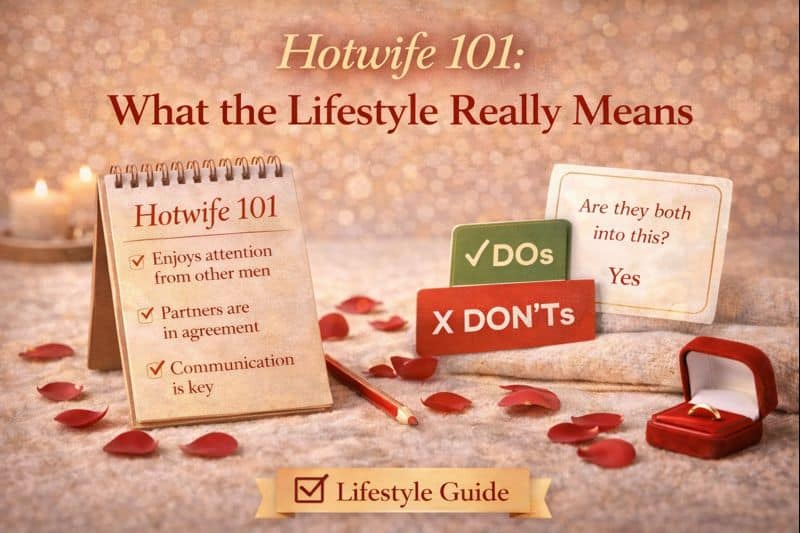
Hotwife 101: What the Lifestyle Really Means
Hotwife & Cuckolding / By Alex