
Cuckolding Explained Without the BS: What It Is, What It Is Not
/ Hotwife & CuckoldingFew topics in the world of consensual non-monogamy generate more confusion, misinformation, and loaded assumptions than cuckolding. The word itself carries centuries of cultural baggage. In its older usage, it was an insult: a man made a fool of by an unfaithful wife. In modern online spaces, particularly in pornography, it has been repackaged into something so stylized and extreme that it bears almost no resemblance to how most couples who identify with this dynamic actually experience it.
Then there is the overlap with related dynamics: hotwife, stag and vixen, and various forms of power exchange. These get conflated constantly, leading people who are curious about cuckolding to assume they are signing up for things they are not, or to dismiss something that might actually resonate with them because the version they encountered first was not an accurate representation.
This article is cuckolding explained honestly, without the pornographic exaggeration, without the cultural shame, and without glossing over the real complexities. It covers what the cuckold dynamic actually involves for both partners, how it differs meaningfully from related dynamics, when and why humiliation is or is not part of the picture, and what healthy versus unhealthy versions of this arrangement look like in practice. If you have been curious but confused, this is the straightforward version you have been looking for.
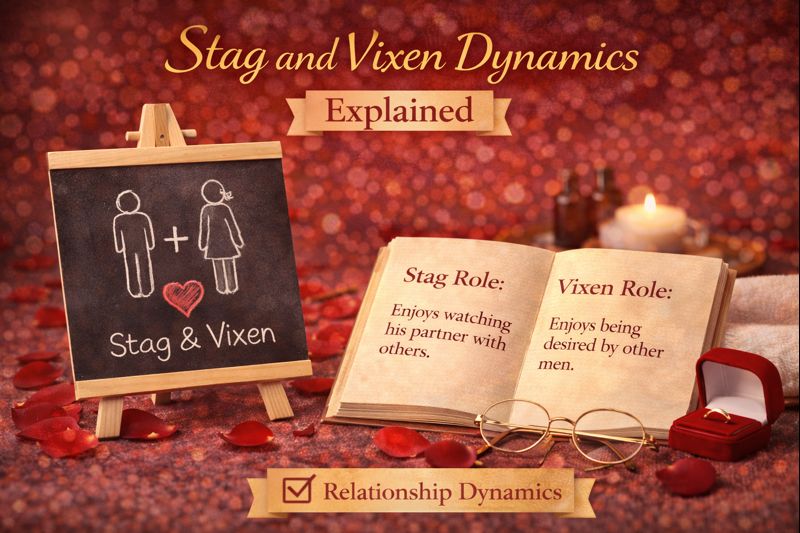
For the foundational context, see Hotwife 101: what the lifestyle really means and stag and vixen dynamics explained.
Why Cuckolding Is So Misunderstood
The misunderstanding of cuckolding operates on several levels simultaneously. The first is historical: the word has been used as a slur for centuries, applied to men who were deceived by unfaithful wives and made objects of public ridicule. This etymology still clings to the word and makes it difficult for many people to separate the consensual modern practice from its origins as a term of contempt.
The second layer is pornographic distortion. The cuckold genre of pornography is one of the most consumed categories online, but it is also one of the most extreme and stylized. It consistently amplifies specific elements, particularly racial dynamics, degradation, and male humiliation, to a degree that is genuinely not representative of how most couples engage with this dynamic. People who form their understanding of cuckolding primarily from pornography are working with a highly filtered, commercially motivated picture.
The third layer is terminological confusion. Cuckolding, hotwife, and stag-and-vixen are used interchangeably in casual conversation despite describing dynamics that differ meaningfully in emotional tone, motivation, and psychological character. This conflation leads to genuine misunderstandings about what any individual couple is actually seeking or practicing.
The result is a dynamic that is simultaneously more common than most people realize and more poorly understood than almost any other practice within ethical non-monogamy. Getting past the noise requires a clear, honest examination of what cuckolding actually is when it is practiced consciously and consensually between adults.
The Actual Definition
In contemporary consensual contexts, cuckolding describes a relationship dynamic in which a man experiences psychological arousal from knowing or witnessing that his committed female partner is sexually involved with other men. The defining characteristic of the cuckold dynamic, as distinct from closely related arrangements, is the specific psychological experience of the male partner: a complex emotional response that typically combines elements of jealousy, vulnerability, and erotic intensity in a way that produces genuine pleasure rather than distress.
This is a crucial distinction. The arousal in the cuckold dynamic is not despite the jealousy and vulnerability. It is, for many men who experience it, fundamentally intertwined with those feelings. The emotional complexity is part of what makes the experience psychologically significant. This is sometimes described as "arousal through vulnerability" and represents a real and documented psychological phenomenon, not a manufactured performance.
Critically, all of this happens within a framework of full consent and transparency. The woman's involvement with other men is not secret, not a betrayal, and not something the male partner merely tolerates. It is an arrangement that both partners have agreed to and, in the healthy version, both find genuinely fulfilling in different ways.
The word "cuckold" in its modern consensual usage refers to the male partner in this arrangement. Some couples use the word comfortably and even with pride. Others prefer to describe the dynamic without the label. Neither approach is wrong.
What the Cuck Dynamic Involves Emotionally for the Male Partner
The emotional experience of the male partner in a cuckold relationship is one of the most psychologically complex aspects of this dynamic, and it deserves careful, honest examination rather than reduction to a simple explanation.
The central emotional feature is a form of erotic response to vulnerability. When a man with genuine cuckold psychology contemplates or witnesses his partner's involvement with another person, the experience triggers a cascade of emotions that includes jealousy, a heightened sense of his partner's desirability, a form of submissive arousal, and often a profound awareness of the primary relationship's significance. For men who experience this authentically, these feelings combine into something that is genuinely pleasurable rather than painful.
This does not mean the experience is emotionally uncomplicated. Many men in cuckold arrangements describe moments of genuine vulnerability, occasional intrusive anxiety, and the need to actively process their emotional responses. The difference between a healthy cuckold dynamic and an unhealthy one is not the absence of difficult emotions but the presence of a structure that allows those emotions to be acknowledged, processed, and ultimately integrated into a positive experience.
Many men in this dynamic also describe a strong element of pride in their partner's desirability. The fact that other people want their partner, and that their partner remains committed to them despite this, often reinforces rather than threatens their sense of the relationship's value. This is psychologically closer to compersion, finding pleasure in a partner's pleasure, than to simple masochism.
There is also frequently a significant intimacy dimension. The emotional vulnerability involved in honestly engaging with this dynamic often creates a depth of closeness between partners that is difficult to achieve otherwise. The cuckold dynamic requires and generates a high level of mutual honesty, trust, and emotional attunement.
The Role of the Woman in a Cuckold Relationship
The woman's experience in a cuckold dynamic is distinct from the male partner's and is often discussed far less thoroughly. This is a significant gap, because her experience is not simply a function of her partner's psychology. She is a full participant with her own emotional landscape, desires, and agency.
In healthy cuckold arrangements, the woman has genuine enthusiasm for the dynamic rather than participating purely to fulfill a partner's fantasy. This enthusiasm often takes one of two forms, though both can coexist. The first is genuine enjoyment of the freedom and sexual variety the arrangement provides, combined with appreciation for a partner who celebrates rather than restricts her sexuality. The second is active engagement with the power dimension of the dynamic: some women in cuckold relationships find genuine pleasure in the relative authority their position confers, and they choose to embody this actively rather than passively.
The woman's genuine desire and agency are not optional elements in a healthy cuckold dynamic. They are foundational. A cuckold arrangement in which the woman is simply tolerating or performing for her partner's benefit, without authentic enthusiasm of her own, is not a healthy consensual dynamic regardless of what agreements are nominally in place.
This also means the woman in a cuckold relationship has responsibilities: to communicate honestly about her own experience, to maintain the emotional safety of the primary relationship, and to be genuinely attentive to her partner's wellbeing rather than treating his vulnerability as an inconvenience to be managed around her activities.
Cuckolding vs Hotwife: Key Differences in Emotional Tone
Cuckolding and the hotwife lifestyle are closely related and are frequently confused with each other, but they describe different psychological landscapes. Understanding the distinction matters both for couples trying to identify which dynamic resonates with them and for those who want to communicate accurately about what they are exploring.
The hotwife dynamic is characterized by mutual excitement and a relatively symmetrical emotional experience between partners. The male partner in a hotwife arrangement typically feels proud and aroused by his partner's desirability. His emotional experience is primarily positive and expansive: he experiences compersion, pride, and shared excitement. The vulnerability element, while present, is not the central psychological feature.
The cuckold dynamic involves a more asymmetrical emotional structure. The male partner's experience is more psychologically complex, involving genuine vulnerability, a submissive or deferential element, and arousal that is specifically intertwined with these more difficult feelings. The jealousy and emotional risk are not incidental to the arousal: they are part of it.
In practice, this difference in emotional tone manifests in how the dynamic is structured and communicated. Hotwife couples tend to emphasize shared excitement and partnership. Cuckold couples tend to have more explicit attention to the power dynamic and the male partner's specific psychological experience within it.
Many couples find themselves somewhere between these poles, and many evolve their understanding of which label, if any, fits them over time. The labels are tools for communication, not boxes that constrain how a relationship must function.
Cuckolding vs Stag and Vixen: Another Important Distinction
The stag and vixen dynamic is often described as the opposite of cuckolding in emotional character, and this framing is largely accurate. Where the cuckold dynamic involves a degree of psychological vulnerability and submissive arousal for the male partner, the stag dynamic is defined by confident male pride.
In the stag and vixen arrangement, the male partner, the stag, experiences his partner's outside connections from a position of secure, almost proprietary pride. There is no submissive dimension, no arousal through vulnerability. The stag is not deferring or conceding. He is actively participating in his partner's desirability from a position of strength. His partner, the vixen, embodies playfulness and sexual confidence, and both partners experience the arrangement primarily through a lens of empowerment and mutual celebration.
This distinction is significant because the psychological profiles that find each dynamic satisfying are genuinely different. A person who is drawn to cuckolding for the vulnerability and submissive elements will not find what they are looking for in a stag-and-vixen dynamic, and vice versa. Applying the wrong framework to a genuine desire is a reliable way to create confusion and disappointment.
See stag and vixen dynamics explained for a thorough treatment of that specific arrangement.
The Humiliation Element: When It Is Present and When It Is Not
Humiliation is probably the single most misunderstood element of cuckolding, and it deserves a direct, nuanced treatment rather than either dismissal or sensationalism.
The reality is that humiliation is present in some cuckold dynamics and entirely absent in others. There is no single correct version of cuckolding, and the presence or absence of a humiliation element does not make an arrangement more or less legitimate. Both versions are real, practiced by real couples, and capable of being either healthy or unhealthy depending on how they are structured.
In cuckold arrangements where humiliation is part of the dynamic, it functions as consensual erotic power exchange rather than genuine degradation. Both partners agree to this element, both find it psychologically fulfilling in their respective ways, and it exists within a framework of mutual care and respect that is distinct from the content of the fantasy. The man who finds erotic pleasure in a specific form of humiliation is not actually being harmed or degraded in any meaningful sense. He is participating in a carefully negotiated role that serves his genuine psychological needs.
In cuckold arrangements where humiliation is not part of the dynamic, the emotional character is warmer and more centered on shared intimacy and vulnerability. Many couples who identify as cuckold couples have no interest in humiliation whatsoever and find the pornographic version of their dynamic alienating and inaccurate. For them, the appeal is in the specific psychological experience of vulnerability and compersion without any degradation dimension.
The critical line is consent. Humiliation that is genuinely agreed to, enjoyed by both parties, and embedded in a relationship of mutual care is categorically different from humiliation that is coerced, one-sided, or used to erode a partner's self-worth. The first is erotic play. The second is emotional abuse. The fact that both can superficially look similar from the outside is precisely why honest, explicit communication about what is wanted and what is not wanted is non-negotiable.
Why Some Men Are Drawn to This Dynamic
The psychology of the cuckold male partner is a genuinely fascinating area that has received increasing attention from researchers and clinicians as consensual non-monogamy has become more openly discussed. Several overlapping psychological explanations account for why this dynamic appeals to a meaningful subset of men.
The evolutionary psychology explanation centers on sperm competition theory. Research in evolutionary biology has documented that men can experience heightened arousal when they perceive their partner as having been involved with another male, an adaptation theorized to have evolved to motivate increased sexual effort and thus competitive advantage. In a consensual, transparent relationship, this evolved response becomes the engine of the cuckold dynamic rather than a source of conflict.
The psychological explanation involving vulnerability and intimacy is equally significant. Many men who are drawn to cuckolding describe a desire for a form of emotional intensity and intimacy that ordinary relationship structures do not easily produce. The vulnerability of allowing a partner full sexual freedom, while remaining committed to her and to the relationship, generates a depth of emotional engagement that many men find both challenging and profoundly connecting.
There is also an element that relates to power dynamics more broadly. Some men find genuine pleasure in a temporary or partial inversion of the typical power structure in heterosexual relationships. The cuckold dynamic, particularly in versions that include some submissive dimension, offers a structured way to explore this without the arrangement defining the entirety of the relationship.
Finally, for some men, the appeal is primarily aesthetic and imaginative: the partner's experience is vivid, present, and intensely erotic in a way that novelty-seeking within a committed relationship rarely achieves through any other means.
None of these motivations requires or implies psychological damage. They reflect genuine variation in human sexuality that exists across cultures and has been documented consistently in both research literature and clinical practice.

What Healthy Cuckolding Looks Like vs Unhealthy
The line between healthy and unhealthy cuckolding is not drawn by the presence or absence of any particular element. It is drawn by the quality of consent, communication, and mutual care between partners.
Healthy cuckolding is characterized by genuine enthusiasm from both partners, honest and ongoing communication about emotional states and needs, firm agreement on the specific parameters of the dynamic including what is included, what is excluded, and how things can be paused or stopped. Both partners feel emotionally safe, both experience genuine benefit from the arrangement, and both feel free to revisit agreements without fear of punishment or withdrawal.
The primary relationship is actively protected in a healthy version of this dynamic. The primary partner's emotional needs are taken seriously and met consistently. Aftercare is present and genuine. The dynamic is a chosen addition to an already stable relationship, not a substitute for a missing foundation.
Unhealthy cuckolding looks different. One partner may be participating primarily out of obligation or fear. Agreements may be vague or one-sided, with one partner's preferences consistently overriding the other's comfort. The dynamic may be used to work out relationship problems rather than to enhance an already healthy bond. One partner may be experiencing genuine ongoing distress while maintaining that everything is fine because the alternative feels too threatening to name.
A particularly important warning sign is when the humiliation or vulnerability elements of the dynamic expand beyond the agreed-upon space and begin to affect how the partners treat each other in daily relationship life. Erotic power play that stays in its designated container is very different from a dynamic that erodes genuine mutual respect outside of explicitly sexual contexts.
How to Approach the Conversation With Your Partner
Bringing up cuckolding with a partner for the first time is a conversation that benefits significantly from careful preparation. The word itself carries associations that can be alarming to someone encountering it without context, and leading with the label is often less effective than leading with an honest description of the actual desire.
Starting the conversation by naming what you find appealing about the specific dynamic, without necessarily attaching a label to it, tends to produce better outcomes than announcing "I want to try cuckolding" and then managing your partner's reaction. Describing the psychological experience you are drawn to, the sense of vulnerability intertwined with arousal, the desire to see your partner fully desired, the specific emotional texture of the fantasy, gives your partner something real to respond to rather than a category loaded with potentially alarming associations.
Creating the right context matters too. This conversation should not happen during an argument, immediately after a difficult experience, or in any setting where one partner feels pressured or ambushed. A calm, private setting where both partners have time and emotional space to respond thoughtfully is essential.
Expect the conversation to take multiple rounds. A partner hearing this for the first time will need time to process, ask questions, research, and return with their own thoughts. Treating the first conversation as the beginning of a series, rather than a single persuasion attempt, reduces pressure and allows both partners to arrive at an honest, shared position over time.
Rules and Agreements Unique to the Cuck Dynamic
Many of the rules that protect hotwife relationships generally also apply to cuckolding arrangements, but certain aspects of the cuckold dynamic call for additional or modified agreements.
Rules around the humiliation element, if it is present, require particular clarity. Both partners should be able to articulate exactly what forms of humiliation are welcome, what the limits are, and what happens when the experience moves outside those limits. A clear stop signal that pauses the dynamic immediately, and a commitment to honoring it without minimization, is non-negotiable.
Communication around the male partner's emotional state is especially important in this dynamic because the vulnerability element means his experience can shift significantly and sometimes unexpectedly. A rule establishing regular, honest check-ins specifically about his emotional state, not just his sexual experience, creates a structured opportunity for this information to surface before it becomes a problem.
Rules about the female partner's outside connections may need to be more detailed in this dynamic than in a hotwife arrangement, particularly around communication during and after encounters, the management of any emotional investment that develops, and the specific ways the male partner is kept informed and included. The degree of involvement or exclusion the male partner experiences is itself a significant dimension of the dynamic and should be deliberately calibrated rather than left to default.
See hotwife rules that protect relationships for the comprehensive rules framework that underlies these more specific cuckold-focused agreements.
Common Misconceptions Addressed Directly
Several misconceptions about cuckolding are so persistent that they deserve direct, explicit responses rather than being addressed only implicitly.
Misconception one: cuckolds are inherently insecure or psychologically damaged. The research does not support this. Men who engage in this dynamic healthily tend to have secure attachment styles and strong relationship foundations. The desire is not a symptom of dysfunction any more than any other consensual sexual preference is a symptom of dysfunction.
Misconception two: cuckolding is always about racial dynamics. This misconception comes directly from the pornographic version of this dynamic, which has particular commercial incentives for emphasizing racial content. In reality, the vast majority of couples who practice cuckolding as a relationship dynamic do not engage with racial framing at all, and those who do so consensually are a minority within a minority.
Misconception three: cuckolding is a gateway to relationship destruction. The evidence from couples who practice it consensually, with genuine mutual enthusiasm and clear communication, does not support this. Like any form of consensual non-monogamy, outcomes are determined by the quality of the relationship structure and communication, not by the practice itself.
Misconception four: the woman is always the dominant partner. Many cuckold arrangements involve no explicit power exchange at all. The female partner's relative authority in the dynamic ranges from minimal to substantial depending on what the specific couple has chosen and finds meaningful. There is no single template.
Misconception five: you cannot change your mind. Couples can and do adjust, pause, or end cuckold arrangements as their understanding of what works for them evolves. No previous agreement obligates either partner to continue something that has stopped serving the relationship.
Join the Community
If you are curious about cuckolding and want to connect with others who understand this dynamic from lived experience, the West Coast Swingers members community offers a respectful, thoughtful space for exactly these conversations. Join the community at members.westcoastswingers.com and find people who can offer real perspective, honest answers, and genuine support as you navigate this territory.
Final Thoughts
Cuckolding is one of the most misrepresented dynamics in all of consensual non-monogamy, and the misrepresentations do real damage. They create shame for people whose desires are genuine and harmless. They create confusion for couples trying to communicate clearly with each other. They produce unrealistic expectations based on pornographic caricature rather than the honest, varied reality of how couples actually engage with this dynamic.
The honest version of cuckolding is a consciously chosen, clearly negotiated arrangement between two adults who both find genuine meaning and pleasure in the specific psychological texture of the dynamic. It is neither the degraded male fool of historical slang nor the extreme performer of internet pornography. It is something considerably more human, complex, and interesting than either of those caricatures allows.
If this dynamic resonates with you, it deserves honest exploration rather than shame or sensationalism. Learn what it actually involves, communicate clearly with your partner, establish agreements that protect both of you, and give yourselves permission to approach this with the same thoughtfulness and care you would bring to any significant relationship decision. The BS version of this dynamic is not worth anyone's time. The real version, when engaged with honestly, is something else entirely.
Frequently Asked Questions
What is cuckolding?
Cuckolding is a consensual dynamic where one partner enjoys their partner having sexual experiences with others, often with an element of erotic submission or anticipation. It is agreed on by both partners and built on trust and communication.
Is cuckolding about humiliation?
Not always. For some couples a degree of playful humiliation is part of the appeal, but for many it is about trust, anticipation, and arousal. Each couple defines what the dynamic means and where their limits are.
How is cuckolding different from the hotwife dynamic?
The two overlap. Hotwife dynamics emphasize the woman's pleasure and freedom, often with pride. Cuckolding more often includes the other partner's arousal from a submissive or humiliation role. The line between them is defined by each couple.
Free for couples
Get the Free Beginner’s Checklist for Couples
Eight steps from the first honest conversation to your first night out, plus new guides, club and event news, and new games. Unsubscribe any time.
Related Posts
Hotwife 101: What the Lifestyle Really Means
Hotwife & Cuckolding / By Alex