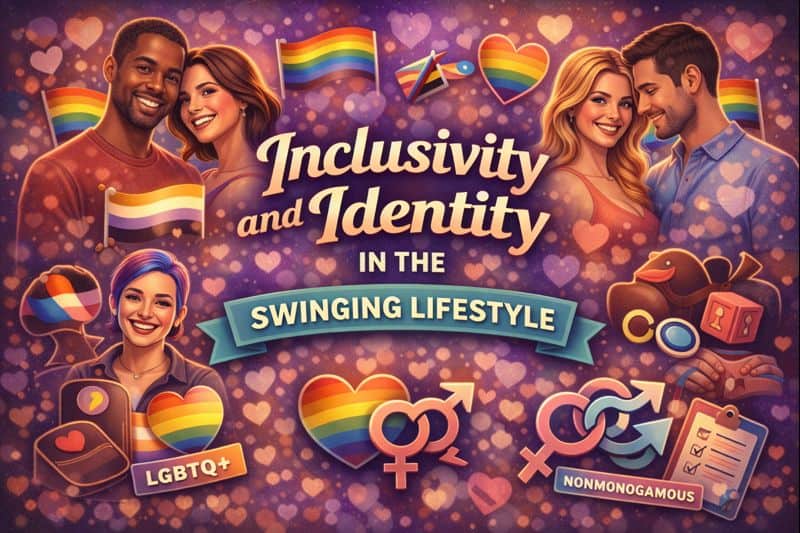

Bisexual vs Pansexual in the Lifestyle
/ Inclusivity & IdentityThis guide explains what bisexual and pansexual mean and how people in the lifestyle use each label. It also covers what a couple should settle before playing with people of any gender. The two words overlap a great deal. They are not the same, and the people who choose one over the other usually have a reason.
Lifestyle spaces attract people across the whole range of attraction. Some attendees are straight, some are bisexual, some are pansexual, and some do not use a label at all. Understanding the vocabulary helps you read profiles accurately, hold better conversations at clubs, and avoid awkward assumptions about the people you meet.
The goal here is clarity, not ranking. Neither label is more advanced, more open, or more correct than the other. Each describes a real way of experiencing attraction, and the person using the word is the only authority on what it means for them.
What Bisexual Means
Bisexual describes attraction to more than one gender. The older, narrower reading was attraction to both men and women. Most people who use the word today describe it more broadly, as attraction to their own gender and to other genders, whatever those genders are.
Bisexual does not mean attraction is split evenly. A bisexual person may lean strongly toward one gender and only occasionally feel drawn to another. The label describes capacity, not a fixed ratio, and that capacity can shift over a lifetime.
In lifestyle spaces the word often gets shortened to bi. A bi-curious tag means someone is interested in exploring same-gender contact but has little or no experience. Bi play refers to same-gender contact during a swap or group scene, and it is a common topic on profiles and in club conversation.
What Pansexual Means
Pansexual describes attraction that does not depend on gender. A pansexual person can be drawn to men, women, non-binary people, and trans people, and gender is not the deciding factor. Many pansexual people say they notice the person first and the gender second, or not at all.
The word came into wider use as language around gender expanded. People who felt that bisexual implied only two genders wanted a term that made the wider range explicit. Others use pansexual simply because it feels like a better fit for how attraction works in their own head.
Pansexual does not mean attracted to everyone. It means gender is not a filter. A pansexual person still has preferences, types, and deal breakers like anyone else. Those preferences just rest on things other than gender, such as energy, appearance, humor, or connection.
How People Describe the Difference
The most common way people explain the split is simple. Bisexual people often describe gender as part of what draws them in, even when they are attracted to several genders. Pansexual people often describe gender as beside the point.
Some bisexual people say they experience attraction differently depending on gender. The pull toward a man might feel different from the pull toward a woman, and they enjoy that contrast. Some pansexual people say the pull feels the same regardless, so a gender-based label never quite fit.
Plenty of people would fit either definition and pick one for personal or community reasons. A person might say bisexual because that is the word they grew up with and the one their friends use. Another might say pansexual because it signals openness to trans and non-binary partners without needing a longer explanation.
None of these explanations is a rule. Ask ten people at a house party and you will hear ten versions. The point is to listen to the version the person in front of you offers, and to take it at face value.
Why the Distinction Matters More to Some People
For some people the label is a core part of identity. They may have spent years working out which word fits, and being called the wrong one feels dismissive. A person who has chosen pansexual on purpose may not want to be summarized as bi, and the reverse is equally true.
For others the label is a quick shorthand and nothing more. They use whichever word gets the idea across fastest and do not mind if a stranger picks the other one. Both attitudes are common in the lifestyle, and neither is wrong.
Context also shapes how much the word matters. A profile needs a short tag, so people often pick the one that fits the checkbox. A long conversation at a meet and greet leaves room for the fuller story. The safest approach is to treat every label as meaningful until the person tells you otherwise.
Trans and non-binary attendees often have a stronger stake in the difference. A label that explicitly includes them signals safety. That does not mean bisexual people exclude them, and many bisexual people are fully open to trans and non-binary partners. It means the pansexual label does some of that reassurance up front.
How the Labels Show Up on Lifestyle Profiles
Most lifestyle profiles ask each partner to choose an orientation. The options are usually straight, bisexual, bi-curious, and sometimes pansexual or a free text field. Couples often list different answers for each partner, and that is normal. One partner may be straight while the other is bi or pan.
Profile tags are blunt tools. A bisexual tag tells you a person is open to same-gender contact in principle. It does not tell you what kind of contact, in which situations, or how experienced they are. The written bio usually carries that detail, and a good profile spells it out.
Read the whole profile before drawing conclusions. A couple where one partner is pansexual may still have firm rules about play. A couple where both partners are listed as straight may still enjoy same-room scenes with mixed groups. The tag is the opening line, not the full answer.
Some profiles use acronyms and shorthand instead of full words. Swinger acronyms can pack a lot of information into a few letters, but they also invite misreading. If a tag is ambiguous, ask in a message before you meet.
How the Labels Show Up in Club Conversation
Club conversation is more relaxed than profile text. People rarely announce a label. Instead the subject comes up naturally, often when a couple explains what they enjoy or asks what another couple is looking for. A phrase like she is bi and he is straight is common and carries no judgment.
Pansexual comes up less often in casual club talk, partly because it is a newer word in these spaces. A person who uses it may explain it briefly the first time. Accept the explanation and move on. Asking for a lecture on the difference in the middle of a social night puts the person on the spot.
Listen for what people actually want rather than the label alone. Someone might say they are pansexual and then add that tonight they are only interested in watching. Someone else might say they are straight and then describe a soft-swap boundary that allows some same-gender touch. The stated preference for the night matters more than the identity word.
Good club etiquette applies here as everywhere. Do not repeat someone's label to others as gossip. Do not tease a person about their orientation, even gently. Treat the information as a small gift of trust.
What a Couple Should Agree Before Playing With Any Gender
A couple's own agreement matters more than any label a third party uses. Before you attend an event where mixed-gender play is possible, sit down together and talk through what each of you is open to.
Start with the difference between attraction and action. One partner may be bisexual or pansexual and still want to keep same-gender contact off the table for now. Another may be straight and completely comfortable with a partner exploring bi play. Attraction is an identity fact. Action is a shared decision.
- Which genders each partner is open to playing with, and in what setting.
- Whether same-gender contact is allowed, and whether it is soft or full.
- How the couple will handle a scene that includes a trans or non-binary partner.
- What either partner can do if they feel uncomfortable mid-scene.
- How you will talk about it afterward, including what felt good and what did not.
A yes, no, maybe list works well for this conversation. Each partner fills one out privately, then you compare. The maybe column often holds the most useful information, because it shows where curiosity and hesitation sit side by side.
Revisit the agreement after every event. Feelings change once something moves from imagination to memory. A partner who was fine with the idea of bi play may feel differently after seeing it, and the reverse also happens. Neither reaction is a failure. Both are information, and a full set of boundaries should be reviewed as often as needed.
Respecting Trans and Non-Binary Attendees
Lifestyle spaces include trans men, trans women, and non-binary people, and their numbers grow as more venues state a welcoming policy. Some of these attendees are bisexual, some pansexual, some straight, and some use no label. Their orientation is separate from their gender, and neither should be assumed from appearance.
Use the name and pronouns a person gives you. If you did not catch them, ask once, politely, and then use them. If you slip, correct yourself quickly and keep going.
Never ask about surgery, medical history, or anatomy as a conversation opener. Those questions are invasive in any setting and doubly so at a social event. If a scene is being negotiated and anatomy is directly relevant, the person will tell you what you need to know. The trans swingers guide covers this in more depth.
Pansexual and bisexual attendees should be especially careful not to treat trans people as a novelty. Being drawn to someone because they are trans, rather than because of who they are, reads as fetishizing and most people can feel it. Approach a trans or non-binary person exactly as you would approach anyone else you find attractive.
How to Ask About Someone's Label Without Making It the Whole Conversation
The best way to ask about orientation is to ask what someone enjoys rather than what they call themselves. A question like what are you two hoping for tonight invites a natural answer that usually includes the relevant detail. The label often surfaces on its own.
If you do want to ask directly, keep it light and brief. Something like are you both open to playing with women or just one of you is clear and easy to answer. The question focuses on the practical point, which is compatibility, rather than asking someone to define their identity.
Once the person answers, move on. Do not ask when they figured it out, whether their partner minds, or how it compares to other people you have met. On a first meeting the label is one fact among many, and the person is more than the fact.
If a person volunteers a label you do not know, ask them what it means to them and then let it go. A short, sincere question shows respect. A string of follow-ups turns a social evening into an interview, and the same rules about approaching couples with ease and patience apply here.
Questions Couples Ask
Is pansexual just a newer word for bisexual?
Not quite. The two overlap heavily, but many people choose one over the other for a reason. Bisexual people often describe gender as part of the attraction, while pansexual people often describe gender as irrelevant to it.
Can a straight person enjoy bi play in the lifestyle?
Some straight-identified people do enjoy occasional same-gender contact in group settings without changing their label. Orientation describes attraction, and behavior in a specific scene may not match it exactly. The person's own description of themselves is what counts.
Should a couple list a label on their profile if one partner is unsure?
Bi-curious is the usual choice for a partner who is interested but inexperienced. If neither option fits, a short honest line in the bio works better than a tag that overstates or understates the truth.
Is it rude to ask someone whether they are bisexual or pansexual?
It is fine to ask once, briefly, when the answer affects whether you are compatible for play. It becomes rude when the question turns into a series of follow-ups or when the label is repeated to others.
Does pansexual mean the person is attracted to everyone?
No. Pansexual means gender is not a deciding factor in attraction. A pansexual person still has types, preferences, and firm limits like anyone else.
What if partners disagree about playing with a certain gender?
The partner who is hesitant has the final say, and their hesitation deserves patience rather than persuasion. Talk it through at home, agree on what feels safe now, and revisit it later. A counselor who understands non-monogamy can help if the conversation stalls.
Join the West Coast Swingers Community
West Coast Swingers is a trusted educational resource for couples exploring the lifestyle. Visit westcoastswingers.com for more guides, or join the private community at members.westcoastswingers.com.
Email: info@westcoastswingers.com | https://westcoastswingers.com/
Final Thoughts
Bisexual and pansexual are two honest ways of describing attraction to more than one gender. Both belong in lifestyle spaces and both deserve to be taken at face value. Neither gives anyone permission to make assumptions about what a person wants tonight. The label opens a conversation. The person finishes it.
For a couple, the more useful work happens before the event. Decide together what each of you is open to, write it down if that helps, and agree on how you will check in. Read the full guide on inclusivity and identity in the lifestyle for more on meeting people of every orientation with respect. When your own agreement is clear, other people's labels become simple facts to respect rather than puzzles to solve.
Free for couples
Get the Free Beginner’s Checklist for Couples
Eight steps from the first honest conversation to your first night out, plus new guides, club and event news, and new games. Unsubscribe any time.
Related Guides
Trans Swingers: A Guide to Safer and More Welcoming Lifestyle Spaces
Inclusivity & Identity / By Alex