

Anonymous Play Fantasies Explained: When Anonymity Is the Point
/ Kink, BDSM & RoleplayAnonymous play as a fantasy shows up across a surprisingly wide range of people, including couples who would otherwise describe themselves as emotionally focused and highly communicative. There is something about the idea of physical intimacy stripped of identity, name, history, and social context that taps into a particular kind of erotic freedom. And yet for many people, this fantasy stays quietly tucked away because it sounds, on the surface, like something they should not want. It sounds like the opposite of everything the healthy sexuality world says to strive for: connection, presence, knowing your partner.
The reality is more layered than that. Anonymous play fantasies are common, they are psychologically coherent, and in the right contexts they can be explored responsibly. What matters is understanding what you are actually drawn to in the fantasy, what the real-world version of that looks like, and how to build the kind of agreements with your partner that make exploration genuinely safe rather than just technically possible. This article works through all of that honestly.
What Anonymous Play Actually Means and Why It Appeals to People
Anonymous play, in its purest fantasy form, means sexual interaction with someone whose identity you do not know and who does not know yours. In practice, the appeal rarely requires literal anonymity. What most people are really drawn to is the psychological state that anonymity creates: freedom from social performance, absence of judgment, a kind of erotic suspension where normal rules of identity feel temporarily lifted. You are not a parent, a professional, a partner with a complicated history. You are just a body experiencing sensation with another body.
For some people, the appeal is about novelty without emotional risk. Meeting someone new and skipping the entire process of being evaluated, liked, or rejected as a person takes a specific kind of pressure off the encounter. For others, it is about the transgressive quality, the sense that something outside normal social rules is happening. And for some couples, the anonymous fantasy is specifically about one partner being experienced by a stranger while the other watches or knows about it, which connects it to hotwife and voyeuristic dynamics more than pure anonymity itself.
None of these motivations are pathological or unusual. Human sexuality has always contained a strong current of fantasy about suspension of identity. Literature, film, and erotic writing across cultures and centuries return to anonymous encounter as a theme precisely because it touches something psychologically real and widely shared.
The Psychology: Why Removing Identity Creates a Different Kind of Freedom
Identity carries weight. Every social interaction involves presenting and maintaining a version of yourself, and sexual encounters are no exception. Even in long-term intimate relationships, people carry a self-concept into the bedroom: the kind of lover I am, the things I am comfortable with, the image my partner holds of me. Anonymous play fantasies strip that away, at least imaginatively. Without an identity to maintain, there is no failure, no embarrassment, no morning-after awkwardness, no shift in how a known person perceives you.
Psychologically, this connects to what researchers call ego dissolution in sexual contexts - not the clinical sense, but the colloquial experience of the socially constructed self becoming temporarily irrelevant. Many people report that the most intensely pleasurable sexual experiences they have had involve a similar quality: complete immersion in sensation and connection without the monitoring self chattering in the background. Anonymous play fantasies are, for many people, a route toward that state through narrative and scenario rather than requiring a specific partner or technique.
It is also worth noting that the fantasy of anonymity and the reality of it are quite different things, and most people who hold this fantasy are not actually seeking a situation where their safety or the safety of others is compromised. The fantasy provides its own complete experience in the imagination. Translating it to reality requires additional architecture: consent, safety planning, and honest partner conversations that the fantasy itself does not need.
Anonymous Play in Lifestyle Settings: Darkrooms, Blindfolds, Strangers at Parties
The swinging and kink communities have developed several real-world approximations of anonymous play that allow people to experience versions of the fantasy in contexts with structural safety built in. Darkrooms at established lifestyle clubs are one of the most well-known. These are spaces, usually dimly lit or genuinely dark, where sexual interaction happens without the visual information that normally drives social assessment. You know you are in a space with vetted, consenting adults, but the individual identities are obscured by darkness. Many people find the experience surprisingly freeing even compared to fully lit group play situations.
Blindfold play serves a similar function within a known group. One partner is blindfolded, and the other partners or their own partner take on the role of the unknown. This is a practical way to create the psychological experience of anonymous play with people you have already met, vetted, and consented with. The blindfolded partner genuinely does not know who is touching them at any given moment, which is the functional core of the fantasy without the logistical and safety challenges of literal anonymity with strangers.
Some lifestyle parties and events are specifically structured around minimal-introduction contact, where guests are encouraged to engage with minimal verbal exchange. These differ from darkrooms in that they happen in lit spaces, but the social contract explicitly deprioritizes getting to know each other as people before physical connection. For couples who enjoy this format, it is worth researching the specific event carefully: the best-run versions have clear consent protocols built into their structure, not just an implicit assumption that everyone is fine with everything. Our guide on swinger silent signals covers the non-verbal communication that makes these kinds of settings work safely.

Safety Considerations That Make Anonymity Actually Work
The appeal of anonymity is partly that it removes the weight of social information. The safety challenge is that some of that social information matters for protection. Knowing someone's name, seeing their face clearly, and having a conversation before play all function as safety filters in normal swinging scenarios. Anonymous or semi-anonymous settings require replacing those filters with structural ones rather than eliminating them entirely.
Established venues provide the most reliable structural safety. A reputable lifestyle club with a membership process, staff presence, and clear rules creates a baseline of safety that a truly anonymous encounter with a stranger does not. When you participate in a darkroom or blindfold scenario at an established venue, you are not actually engaging with completely unknown people: you are engaging with people who passed through the same entry process you did, who are accountable to the same venue policies, and who are surrounded by staff who can intervene if needed.
STI risk is a specific consideration in anonymous settings. If you are engaging in scenarios where you cannot clearly see or confirm what is happening, maintaining personal safe-sex practices without relying on verbal negotiation becomes important. Deciding in advance what you will and will not do, and holding those lines regardless of in-the-moment dynamics, is especially important in anonymous contexts. Our guide on swinger consent rules provides a solid foundation for building these kinds of pre-agreed personal frameworks.
Negotiating Anonymous Play Beforehand With Your Partner
The conversation about an anonymous play fantasy needs to happen well before any actual scenario, and it needs to be genuinely two-way rather than one partner convincing the other. Start by separating the fantasy from the real-world version. Does your partner share the appeal of the fantasy when you each imagine it separately? Or does one of you feel excited and the other uncertain? Those are very different starting points and they lead to very different real-world plans.
If both partners are interested, the next conversation is about what specifically appeals to each person. The aspects that excite one partner may be quite different from what excites the other, and understanding both sets of motivations helps design a real-world scenario that actually works for everyone. Someone who is drawn to the freedom-from-judgment aspect may be perfectly satisfied by a blindfold scenario with a known couple. Someone whose appeal is more about the genuine novelty of an unknown body may need something closer to a structured darkroom experience. These are not the same scenario and they require different planning.
Establish clearly in advance what kinds of activity are within scope, what the exit conditions are, and how you will check in with each other afterward. Anonymous play scenarios can produce unexpected emotional responses in both partners, and agreeing ahead of time that you will have a no-blame debrief conversation the next day removes pressure from the in-the-moment experience.
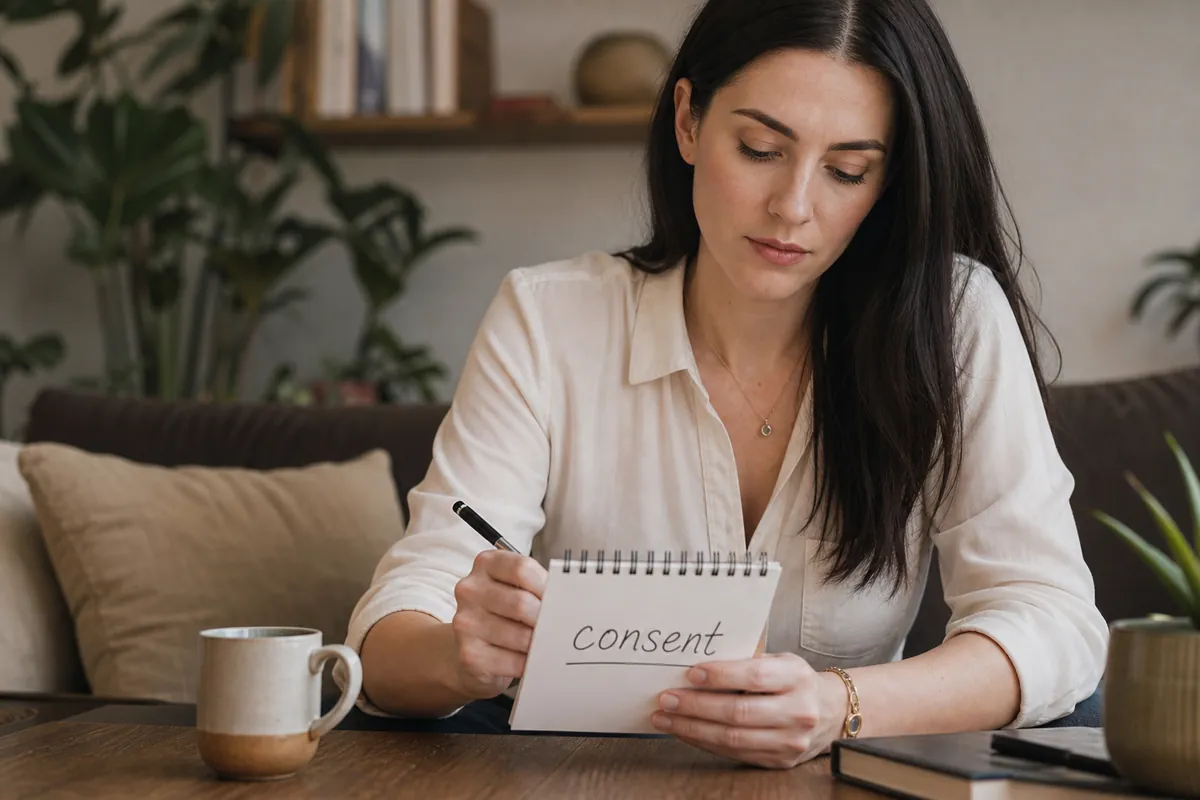
The Consent Paradox: How Do You Consent to the Unknown?
This is the genuine philosophical knot at the center of anonymous play, and it deserves a direct answer. You cannot give informed consent to specific acts with a specific person you have not identified, but you can consent to a defined category of experience within a defined set of conditions. That is what makes lifestyle-context anonymous play possible: you are consenting to participation in a structured scenario with specific parameters, not to whatever might happen.
Think of it as consenting to a set of conditions rather than to a set of specific acts. "I consent to being touched by unknown partners in this darkroom setting, in ways I personally enjoy and have pre-defined, while I retain the right to stop at any time" is a coherent consent framework. "I consent to anything because I am anonymous" is not. The former gives you agency within the scenario. The latter is an absence of consent framed as freedom, and it creates risk both for you and for the people you encounter.
The right to withdraw at any time is non-negotiable in anonymous play settings, just as it is in all consensual contexts. If you find yourself in a scenario that has moved past what you agreed to or what you are comfortable with, you have the same right to stop that you have in any other sexual context. Anonymity does not change that. If you are exploring these scenarios through our community, the principles in our swinger consent rules article apply directly here.
Establishing Your Personal Limits Within an Anonymous Scenario
One of the most important preparation steps for any anonymous play scenario is deciding clearly in advance what your personal limits are and making sure they are understood by anyone who will be part of the scenario. In a blindfold scenario with a known couple, this happens through direct conversation before the blindfold goes on. In a darkroom setting at a venue, it requires knowing your own limits well enough to enforce them yourself without relying on external negotiation.
Practical limits to decide in advance include: which body parts and activities are in play and which are not, whether penetrative sex is included or only external touch, whether you will use specific signals to indicate enthusiasm or discomfort (a squeeze for yes, a tap for stop), and how you will handle a situation where someone proceeds past a limit. Having these decisions pre-made, rather than trying to navigate them in the moment in a dimly lit environment, is the difference between an empowering experience and a confusing or harmful one.
Establish a clear stop signal with your partner before any anonymous scenario. A verbal safeword works in most contexts, but in a true anonymous setting where verbal communication is limited, a physical signal such as a double tap on the nearest surface or person is more reliable. Both partners should know the signal, and both should know that using it ends the scenario immediately with no questions asked in the moment.
When Anonymous Play Goes Wrong and How to Handle It
Anonymous play scenarios can go wrong in a few different ways. Someone may proceed past stated limits. The emotional experience may be very different from what either partner expected, in ways that feel destabilizing rather than liberating. A partner may feel unexpectedly jealous, hurt, or disconnected in a way they did not anticipate going in. These outcomes are not failures, but they do require a clear response plan.
If a limit was violated, the response is the same as in any consent violation: the scenario stops, both partners check in, and you do not proceed further that night. What happened needs to be addressed directly, not minimized or pushed past. If it happened in a venue context, reporting to venue staff is both appropriate and important for the safety of others at the same event.
If the issue is unexpected emotional fallout rather than a consent violation, the response is a slower and more careful debrief. Give both partners a few hours before trying to have the detailed conversation. People often need to sit with unexpected feelings before they can articulate them clearly. The goal of the debrief is not to assign blame or reassure each other prematurely, but to honestly share what each person experienced and what it means for future choices. Our article on CNC covers related territory around how to navigate intense kink scenarios that produce unexpected emotional responses.
How to Discuss This Fantasy With Your Partner for the First Time
Bringing up an anonymous play fantasy for the first time requires the same approach as introducing any significant kink topic: low pressure, genuine curiosity, and no agenda for a particular outcome. The goal of the first conversation is not to get a yes, but to find out where your partner stands and to understand what aspects of the idea they might find interesting versus what parts might concern them. Framing it as something you have been curious about and wanted to share, rather than a request for a specific experience, takes the pressure off both of you.
Be prepared for a wide range of responses. Some partners will be immediately curious and engaged. Some will want time to think about it before responding. Some will have concerns or reservations that are worth exploring rather than dismissing. And some will simply not be interested, which is a complete and valid answer. If your partner's response is uncertain or cautious, that is not a closed door. It is an invitation to have a slower conversation about what specifically appeals to you and what concerns them, and whether there is a version of the idea that works for both of you.
For many couples, the fantasy itself provides plenty of erotic material without needing to become a real-world scenario. Sharing a fantasy verbally or in erotic writing, or incorporating it into role-play scenarios with each other, can honor the appeal of the idea without requiring the logistical and emotional complexity of a real anonymous play situation. That is a valid and satisfying path that many couples find more than sufficient.
Connect With the West Coast Swingers Community
The West Coast Swingers member community is a place where you can connect with couples and singles who approach the lifestyle with genuine thoughtfulness. Whether you are exploring anonymous play fantasies, looking for like-minded people to discuss kink interests with, or simply wanting to find your footing in the community, members here bring real experience and genuine openness. Visit members.westcoastswingers.com to create your profile and find your people.
Free for couples
Get the Free Beginner’s Checklist for Couples
Eight steps from the first honest conversation to your first night out, plus new guides, club and event news, and new games. Unsubscribe any time.
Related Posts
CNC Explained Clearly: What It Means and How to Explore It Safely
Kink, BDSM & Roleplay / By Alex